 CONTACT
 QUICK CALL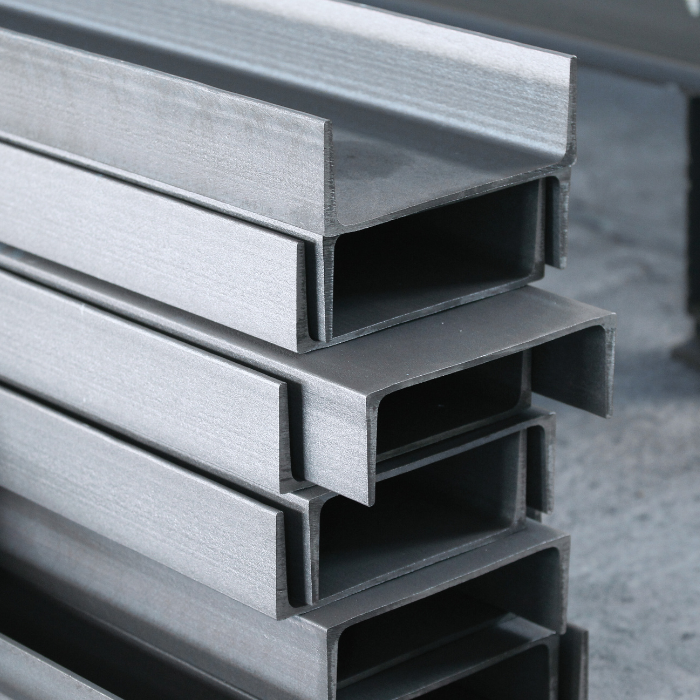
Steel channels provide durable load-carrying performance, lateral stability, and reliable structural support for framing, bracing, equipment platforms, stringers, and fabricated assemblies across commercial, residential, industrial, OEM, masonry, infrastructure, and landscape projects. Channel profiles offer predictable strength, efficient installation characteristics, and versatility in both vertical and horizontal orientations, supporting consistent structural integrity in a range of construction and engineering applications.
Central Steel Supply Company provides specification-compliant steel channel profiles designed to meet structural and fabrication requirements. The following sections outline available channel types, dimensional distinctions, coordinated processing services, and common applications.
Dimensions, Grades, and Value-Added Support
Steel channels are supplied in several industry-recognized profile categories. Each category is dimensioned differently and is used for distinct structural purposes.
Standard Structural Channels—designated with a “C” (e.g., C8 × 11.5)—feature tapered flanges, with flange thickness increasing toward the web. These profiles are used for framing, bracing, and support systems requiring predictable structural performance. A lighter structural variant, often referred to as a “Junior Channel”, follows the same tapered-flange geometry but in reduced-weight sizes for applications where full structural capacity is not necessary while a true structural shape is still required.
***Note: Junior channels are distinct from bar channels in that bar channels are non-structural merchant shapes with square, uniform edges rather than tapered flanges. Bar channels are rolled from bar-stock material and are suited for fabrication components, trim, light supports, and miscellaneous steel applications—not for engineered load-bearing systems where structural or junior channels are required.***
Dimensioning Identified by:
- Shape Designation (“C” for Standard Channels)
- Flange Depth of Section – vertical measurement (in inches) from flange tip to flange tip.
- Weight per linear foot
Example: C8 × 11.5 = “C” for Standard Channel, 8″ nominal depth, 11.5 lb/ft
MC Channels (Miscellaneous Channels) — designated with “MC” (ex. MC10 x 8.4)—are produced from rolled shapes with parallel flanges, resulting in a more uniform flange thickness compared to standard structural channels. This design supports improved fit against flat surfaces and enhanced compatibility with bolted or welded connection systems.
Dimensioning Identified by:
- Shape Designation (“MC” for Miscellaneous Channels)
- Flange Depth of Section – vertical measurement (in inches) from flange tip to flange tip.
- Weight per linear foot
Example: MC10 × 8.4 = “MC” for Miscellaneous Channel, 10″ nominal depth, 8.4 lb/ft
***Note: A stair stringer channel refers to a structural channel used as the load-bearing side member of a staircase. The term “stringer” describes its function—supporting stair treads, risers, and live loading throughout the stair system. Stringer channels commonly utilize MC shapes due to the parallel flange design, which provides a consistent surface for stair tread attachment and simplified alignment.***
Bar Channel is a non-structural alternative to junior channels, providing a lighter-duty profile with square, uniform edges suited for framework, trim, architectural elements, edging, machinery guards, and fabricated assemblies. Unlike junior channels—which retain tapered flanges and structural geometry—bar channels are merchant shapes rolled from bar-stock material and intended for fabrication and miscellaneous steel applications, not engineered load-bearing systems.
Dimensioning Identified by:
- Flange depth of section – vertical measurement (in inches) from flange tip to flange tip.
- Flange width – horizontal measurement (in inches) across the outer edges of the flanges.
- Web thickness
Note: This dimensioning difference distinguishes bar channel from structural C and MC profiles because the channel is not identified by weight per foot.
Example: Bar Channel 2″ × 1” x 3/16″ = 2″ flange depth, 1” flange width, 3/16” web thickness
Stocked Ranges
Central Steel Supply Company supplies both structural steel channels and bar channels in the most commonly used size ranges for construction, fabrication, and general-purpose applications.
- Standard C-Channels: 3″ through 15″ depth (multiple weights available)
- MC Channels: 6″ through 12″ depth (multiple weights available)
- Bar Channel:
- 1” x ½” x ⅛”
- 1 1/2 “ x ½” x ⅛”
- 2” x 1” x ⅛”
- 2” x 1” x 3/16”
Common Channel Grades
- A1011 Commercial Quality (CQ) – Most common for bar channel
- ASTM A36 – Most widely used; general structural applications
- ASTM A572 Grade 50 – Higher strength; frequently used where added capacity is required
- ASTM A588 – Weathering steel for outdoor and exposed conditions (when available)
Lengths and Value-Added Support
Steel channels are available in lengths up to 50 feet depending on profile and weight. Material can be provided to specified lengths through coordinated processing services that support efficient customer workflows. Supplying channel profiles to required dimensions reduces job-site handling, minimizes waste, promotes schedule efficiency, and contributes to long-term business relationships by supporting the overall success of each customer’s project.
Processing Services for Steel Channels
Central Steel Supply Company supports a full range of coordinated processing capabilities designed to improve material accuracy, enhance workflow efficiency, and contribute to dependable installation results. Processing can be accomplished through company resources or trusted partners.
- Saw Cutting: Precision saw cutting—including miter-cut capability—allows channels to be supplied at required lengths, supporting accurate alignment and minimizing shop and field preparation.
- Drilling, Slotting & Scribing: Drilling and slotting services provide accurately located holes, slots, and cut-out openings that support consistent bolted connections and predictable assembly. Scribing and part-number marking can also be incorporated to identify orientation, connection locations, and installation placement clearly, helping streamline job-site sequencing and reducing field-level adjustments.
- Coping: Web or flange coping can be coordinated to support proper fit at intersections with beams, tees, or other channel members. This preparation reduces field modification and supports efficient installation timelines.
Additional Note: Angle Clips
When preparing channels for installation, it is beneficial to coordinate angle clips as part of the overall connection package. Central Steel Supply Company offers angle clips and complementary connection materials and fasteners, helping streamline procurement and support efficient structural assembly.
CAD File Integration
CAD files and detailed shop drawings can be incorporated directly into processing programming to achieve accurate hole placement, cut geometry, dimensional control, and marking details. Central Steel Supply Company maintains a full CAD department for generating or refining drawings as needed and can also partner with trusted detailing resources to assist with shop drawings, connection detailing, and quantity takeoffs. These coordinated capabilities support overall workflow predictability, reduce delays, and contribute to each customer’s long-term project success.
Industries and Common Applications
Steel channel profiles support a broad range of structural and fabrication requirements across multiple markets.
- Commercial Construction and Engineering: Stair stringers, floor and roof framing components, lintels, headers, support members.
- Residential Construction: Basement beams, stair stringers, deck supports, framed openings, and load-transfer elements.
- Municipal & Infrastructure: Utility supports, platform stringers, walkway frames, drainage structures, transit-related assemblies.
- Industrial: Equipment platforms, conveyor support frames, processing lines, structural bracing.
- Original Equipment Manufacturing (OEM): Machinery frames, structural housings, equipment supports.
- Masonry: Lintels, embedded supports, framed openings, shelf-angle systems.
- Landscape Construction: Retaining components, exterior stairs, pedestrian bridges, and structural site elements.
Contact Us for a Quote Today
Partnering with a supplier that delivers reliable inventory, precise material accuracy, dependable service, and strong technical expertise helps create lasting business relationships and elevates overall customer success. Central Steel Supply Company provides steel products and value-added services that enhance efficiency, reduce delays, and keep projects moving with consistent productivity. Quotes for material availability and processing options are available upon request.